One Year After the Fall of Assad
This article was originally published in heatwave magazine
By Têkoşîna Anarşîst
One year after the fall of Assad, war has returned to Syria once again. The transition agreements signed by Mohammed al-Jolani and Mazlum Abdi in March of 2025 have been scrapped. Despite their best efforts at careful—at times even painful—diplomacy, The Democratic Autonomous Administration of North and East Syria was only able to delay the inevitable war that once again arrived at their gates.

The downfall of a tyrant often becomes a lynchpin in the revolutionary process. One year after the collapse of the al-Assad regime in Syria, the revolution of Rojava faces tough questions, fresh challenges, and a new enemy. To fully understand the state of the revolution in the current conjuncture, we reflect on the major developments of the previous year.
A new regime on the horizon
On December 1, 2024, Syrian Democratic Forces (SDF) regional command informed us that a general emergency was being declared across Rojava. Two days before Hay’at Tahrir al-Sham (HTS) had started a new military offensive in Idlib and broken through the lines of the Syrian Arab Army (SAA), under the command of Bashar al-Assad, near Aleppo. At the same time, the mercenaries of the Syrian National Army (SNA, the proxy force of Turkey in Syria) started to attack SDF controlled areas. The frontlines between the SDF and the SNA rapidly heated up, with attacks in the western region of Shehba (near Afrin) and more bombing than usual in the occupied strip between Serekaniye and Gire Spi, along the contested M4 Highway.1
On December 4, after rumors circulated on social media that the leader of HTS had been killed in a Russian bombing, a man known at the time as Mohammed al-Jolani dispelled them by releasing a public video from the citadel in Aleppo. He was wearing a green military shirt instead of the camo uniform and turban he had worn during a press conference announcing the formation of HTS in 2017. He had also trimmed his beard, attempting to appear more moderate in the eyes of Western media. Two days later, when he gave an exclusive interview to CNN, it became clear that something was up.
Soon after, on December 8, al-Assad fled Syria for Moscow. The leader of the HTS, Mohammed al-Jolani, quickly took his place, receiving diplomatic visits and journalists at the presidential palace in Damascus. Not tired of the charade, he swapped his olive drab guerilla attire for a politician’s suit and tie. To complete the transformation, he also stopped using his jihadist nom de guerre, exchanging it for his legal name, Ahmed al-Sharaa, before finally claiming the Syrian presidency.2

Syrians across the diaspora celebrated the collapse of the regime, convinced that whatever came next would have to be better. The twelve-year civil war had left over half a million dead and several million displaced, while foreign powers competed to impose their agendas on the country. The future was still filled with uncertainty, but that did not dampen the celebratory mood. There was dancing in the streets, and many statues of the al-Assad family came crashing down as people celebrated the fall of the regime. Amidst the fear and uncertainty, those days became an unexpected wellspring of hope and euphoria. We could almost taste freedom and peace, knowing that a brutal 50 year-long regime had finally ended.
We closely followed those developments from Rojava, the liberated lands within war-torn Syria, where the Kurdish-led revolution had become a source of hope, not only for Kurds, but for many Arabs, Assyrians, Armenians, and people from other ethnic communities that call Syria home. Many international revolutionaries have traveled here over the course of the Syrian Civil War, some motivated by the war against ISIS, some by the ideals of the Kurdish Liberation Movement. Those ideals were called “democratic confederalism,” a framework developed by Abdullah Öcalan during his years in Turkish prison where he is still captive today. The proposal was the construction of a stateless, classless society, where communes, cooperatives, and academies are the fundamental units of self-administration and self-defense of the people.
In the eight years that we have been in Rojava, we’ve seen two authoritarian systems collapse: first the Islamic State and now the al-Assad regime. As new forces line up to fill the power vacuum left by al-Assad, it is still uncertain how this collapse will impact Syrian society and the Kurdish-led revolutionary project. First and foremost, among these new forces is the fundamentalist coalition under Jolani, which initially presented itself as a democratic alternative to the regime and claimed the legacy of the Arab Spring. Jolani concealed his past involvement as a jihadist and adopted a more moderate appearance. He was careful not to disclose that he had received funding from the caliphate of the Islamic State, Abu Bakr al-Bagdadi, to establish al-Qaeda in Syria and cautiously crafted a palatable image of himself as a reformer who could stabilize a chaotic war-torn region. Jolani’s star quickly rose, while Assad’s regime became a thing of the past in a matter of weeks. We were entering a new reality, with a new autocratic regime on the horizon. 3
The Blitz that swept Syria
In November 2024, a coalition of military groups in Idlib, located in northwestern Syria, led by Hay’at Tahrir al-Sham (HTS)4 launched a broad military operation against Bashar al-Assad’s regime. This offensive, backed by the Turkish state and with tacit support from Western powers, used locally produced drones on a scale never seen before in Syria. Bashar al-Assad’s allies were distracted elsewhere: Russia was busy in Ukraine, and Iran was focused on the Israeli offensive against Hezbollah in Lebanon and Hamas in Gaza. Of course, this is a simplification, and much more could be said about the role of different geopolitical forces in Syria. Nevertheless, the result was that the HTS advanced through the lines of Assad’s forces in a matter of weeks.

Although there were some clashes in Aleppo,5 within the first few days it became clear that HTS was focused on fighting the regime army rather than the SDF forces stationed in Ashrafiya and Sheikh Makhsoud (the majority Kurdish neighborhoods in Aleppo). After expelling regime forces and their military supporters from Aleppo, HTS soldiers moved forward towards the cities of Hama, Homs, and finally Damascus. The conscripted soldiers of the regime, cold, hungry, and scared of the approaching enemy, deserted their barracks and fled. Russia attempted a handful of symbolic air attacks alongside a few scattered responses from Hezbollah, but the offensive did not meet significant resistance anywhere. We were cautiously optimistic; it appeared that the future rulers of Syria were uninterested in picking fights with the SDF. Now, a year later, the cards have been dealt, and we have a better sense of our hand.
Turkey, who would be the ultimate dealer, has never relented in its hostility towards Rojava, and it used the chaos of the blitz to attack it. The SNA, trained and armed by the Turkish state, with salaries paid in Turkish liras, attacked the region of Shehba and its main town Tal Rifaat. That region was home to several refugee camps housing those who escaped the invasion of Afrin back in 2018. These refugees were displaced from their homes once again under the threat of executions, kidnappings, and looting—standard practice for Turkish mercenaries. They fled towards other regions under the control of the SDF, unaware that they would be displaced again a year later when the SDF was forced to retreat even further. Shortly after the occupation of Tal Rifat, the SNA moved on to attack Manbij. Kobane, a city symbolic for its resistance against ISIS in 2015, strategically located on the other eastern side of the Euphrates River along the Turkish border, was now in the crosshairs of the SNA.

Qereqozah Bridge and the Tishrin Dam, crossings over the Euphrates which separates Manbij and Kobane, became vital choke points where the SDF was able to break the advance of SNA. Waves of attacks were launched against both bridges, but the SDF—together with the support of civilian convoys that travelled to support the resistance—held strong. People from across northeast Syria vigilantly guarded the dam for months, manifesting the classic antifascist watchword from the Spanish Civil War, “No Pasaran.” The defense of Tishrin serves as a powerful illustration of successful resistance, reflecting the unity and maturity of a revolutionary movement where military and civilian political struggles were inextricably intertwined.
Of course, resistance came with a price. For over 3 months, civilian convoys that were organized across the DAANES to support Tishreen Dam became the target of Turkish drones and mortars. More than 20 civilians were killed, among them several important figures from Kurdish civilian life, including Kurdish comedian Bave Teyar and two Kurdish journalists, Cihan Bilgin and Nazım Daştan. After a ceasefire agreement in March 2025, the civilian convoys to Tishreen Dam ended. The Turkish state’s opportunistic attempt to gain control of northeast Syria while HTS advanced on Damascus had failed. The revolution in Rojava had survived and looked like it might have a seat, albeit a short lived one, at the table of the new coalitional power emerging in Syria.

Shortly after Bashar al-Assad fled the country, the Syrian Salvation Government, an administrative body linked to HTS that was running Idlib, relocated to Damascus. There was some minor reshuffling of names after negotiations and agreements with other forces, accompanied by a handful of scandals. One of the most egregious was a video from 2015 where the new Minister of Justice, Shadi Mohammad al-Waisi, appeared on the streets of Idlib reading death sentences for women accused of prostitution. These women were shown being shot in the head after he finished his verdict. Others included a statement by Aisha al-Dibs, the only female member of the transitional government, who called on women “not to go beyond the priorities of their God-given nature”. These positions are in direct opposition to the women’s revolution in Rojava, whose central slogan “Jin, Jiyan, Azadi” (Women, life, Freedom), rejects state violence against women.
On January 29th the main military leaders of HTS and SNA groups gathered in the presidential palace of Damascus to celebrate what they called the “Conference for Announcing the Victory of the Syrian Revolution” (Arabic: [مؤتمر إعلان انتصار الثورة السورية]). SDF was not invited, nor were the armed Druze groups or other armed factions in Syria. In that closed conference, al-Jolani was declared president of Syria, only one month after the US removed a bounty of 10 million dollars from his head.

Agreements and massacres
After a violent winter filled with military offensives, the situation seemed to have settled down and negotiations began. The prior leader of HTS sitting in the presidential palace was an important victory for Turkey, even though its proxy force had failed to push the DAANES to the east of the Euphrates. Israel, also seeing an opportunity, launched the biggest air campaign in Israeli history. A series of air strikes at the end of February wiped out all of the Syrian Arab Army’s remaining advanced weaponry, with nearly 90% of military capabilities reportedly destroyed. Air defenses, munitions factories, and the navy were the primary targets, but many armored vehicles and military bases were also demolished. The IDF also expanded their occupation of the Golan Heights to a “buffer zone” in southern Syria under the guise of blocking potential Hezbollah supply routes—in reality, making sure that Syria’s new rulers would not pose a threat to Israel.
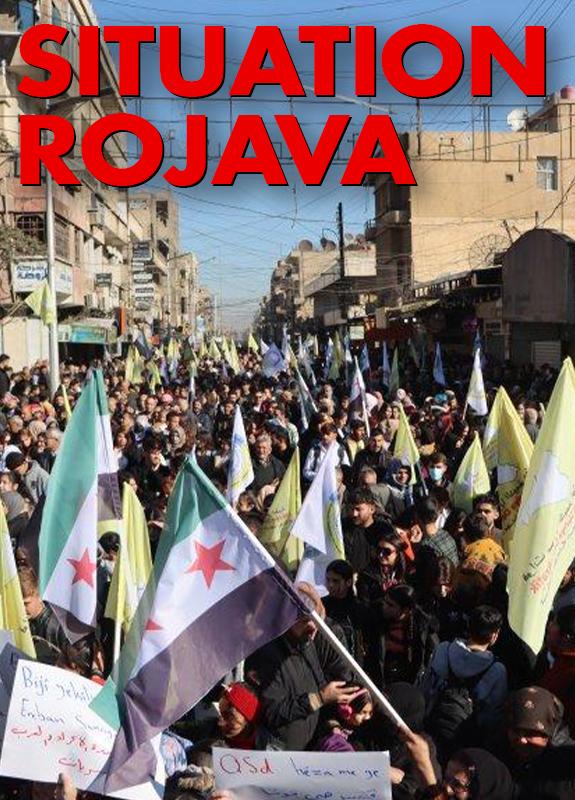
In the midst of this, HTS and SDF attempted to create agreements for coexistence. Mazlum Abdi, the commander in Chief of the SDF, and al-Jolani, the provisional president of Syria, had been in communication to avoid direct confrontation in Aleppo where they both had forces present. During the more than decade long conflict, DAANES had been the most stable region in Syria, both politically and economically. During this time, the Kurdish-led administration had never called for secession from Syria, but for a democratic and federated country. In early 2025, the main administrative buildings of the DAANES began displaying the Syrian independence flag next to the Rojava flag, a gesture signaling their desire to build a new Syria rather than pursue a secessionist agenda. Many demonstrations were organized in major cities like Qamishlo, where SDF’s flag and the independence flags flew side by side.
SDF also made some military advances in the winter following the collapse of the regime, taking control of some areas in the south of Raqqa and the city of Deir Ezzor. Such advances were needed to counter the increasing level of activity from ISIS sleeper cells, who were also taking advantage of Assad’s collapse to raid towns and military depots in the central desert areas of Syria. Deir Ezzor’s oil fields are strategically valuable to the US—and as such the US agreed to offer conditional support to the SDF to ensure those fields did not become a revenue stream for ISIS once again. The oil fields have also become a priority for the new administration in Damascus, who hope to generate enough profits to fund the fragile new state. As an overture during the peace negotiations, the SDF made the concession of handing over Deir Ezzor, with the hope of building some goodwill. Such steps were also necessary to calm tensions with Turkey, who was openly threatening to enter Syria and wipe out the Autonomous Administration. While this bought the SDF time, in the long run these concessions and gestures did not win them any lasting goodwill.

Meanwhile, the provisional government in Damascus was in a strong position: they could count on the full support of Turkey, as well as formal recognition from many Arab and Western states. This provided them with the legitimacy to rule as the new authority in Syria and paint their power grab as a necessary step to break free from the brutality of the Assad regime. It was no secret that their military force was comprised mainly of fundamentalist Sunni Muslims, leaving other minorities uncertain about what might happen next. The transitional government staged symbolic meetings with religious figures from these different minorities to deter such fears, promising peace and stability for all ethnic groups in Syria. However, it soon became clear that these promises were merely smoke and mirrors.
At the beginning of March 2025, HTS started military operations in the coastal areas of Latakia, where majority Alawite communities live.6 HTS soldiers unleashed attacks against the Alawite population, with brutal sieges and executions of civilians. SNA brigades joined those operations, many of them making public calls for “Jihad against infidels.” Entire villages were raided, with the brutality broadcast over social media. Those videos revealed to the outside world what many already suspected: despite their portrayals in Western media, the new rulers of Syria were far from the democratic reformers rebelling against a tyrannical regime. To protect his newly minted image as a moderate and reformer, Al-Jolani called for investigations into the massacres, a clever diversion to calm tensions and delay any consequences for the sectarian violence orchestrated by his soldiers.
On March 10, while those massacres were still ongoing, a symbolic ceremony with Mazlum Abdi and al-Jolani was held in Damascus. They signed a memorandum of understanding, that emphasized their joint will to work together for a peaceful and inclusive Syria. That agreement was intended as a cornerstone for further negotiations, establishing dialogue committees with the task of developing a proposal by end of the year. These talks were to define how the institutions of northeast Syria—civilian and military—were to be integrated in the new Syrian state. Included in the negotiations were Kurdish rights and the right of return of people displaced by the war. However, the language employed was vague and the memorandum was not legally binding. It was just a statement of good intentions and cooperation—nothing more. The deadline decided for implementation was by the end of the year. But as the year closed, we saw that different plans had been drawn up in its place.
Integration and Dissolution
Until very recently, the ongoing negotiations were a lively topic of discussion in the streets of northeastern Syria. Everyone was tired of war. Everyone had lost relatives and loved ones at the frontlines. Although it was clear that any agreement with the provisional government would require significant concessions, there was also a consensus that giving up most of the advances made during the revolution would be unacceptable. The question then became how much DAANES was willing to concede to avoid a new war—one that would ultimately be forced upon them despite their attempts at diplomacy. Now, in hindsight, it appears that the lines of concessions were always receding towards the redlines of the Kurdish movement.

The negotiations for integrating into the new Syrian state focused on two key processes: the integration of SDF forces into the military and the reorganization of the civilian administration. Damascus has demanded that the SDF dissolve and integrate its members as individuals into the new Syrian Army. In a counterproposal, the SDF insisted that it join the Syrian army as regiments that abided by the command structure of the Syrian Army. This counterproposal would ensure that the armed forces of northeast Syria remained intact. One of the most important yet still unresolved questions in this integration process is the fate of the Women’s Defense Forces (YPJ). The YPJ are the vanguard of the women’s revolution, empowering women not just to take arms, but also to assume leadership in civilian and military roles. The Islamist government in Damascus has no interest in gender equality or women’s freedom, and this is a point on which the SDF is not willing to budge.
The civilian administration raised its own questions, such as the fate of the co-chair system implemented in the DAANES to ensure equitable leadership in civilian institutions. In addition to gender representation, the co-chair system also promotes ethnic and religious diversity, creating a system in which one can find Kurdish women and Arab men working together as co-presidents on regional councils. Another major point of contention was students’ right to education in their mother tongue. Since declaring autonomy, schools in Rojava, from pre-schools to higher education, have been studying in Kurdish. Indeed, the struggle over linguistic freedom has been central to the Kurdish movement that is active in four countries (Turkey, Syria, Iraq and İran). Al Jolani’s government would like to limit Kurdish to a 2 hours-per-week foreign language elective.
Much has been written about Democratic Confederalism, so we won’t elaborate more here. But briefly, DAANES was based on local communes that come together in regional councils. These regional councils then form canton institutions and a federal congress where delegates coordinate their policies and work.7 It is a complex system based on the idea that implementing true democracy necessitates a formal ground-up decision-making process that limits centralized state power. It encourages people to take responsibility over their lives and find solutions to social problems through collective discussion and action.
With three regional powers vying for control, what happens in Syria rarely stays in Syria. In particular, the interests of the Turkish state have negatively impacted the negotiations in Damascus. For Erdoğan, the revolution in northeastern Syria is a threat to his Neo-Ottoman imperialist agenda. He would prefer a Syria that is a servile Turkish protectorate. The Turkish state has fought a protracted war against the Kurdish liberation movement, both within and outside its borders. The military operations in Afrin during 2018 and along the Gire Spi-Serekaniye strip in 2019 established Turkish-occupied regions in Syria, with Turkish soldiers on the ground and Turkish language taught in schools. Turkish diplomats have not concealed their desire to control these territories, like they control Northern Cyprus and the Caucuses. Meanwhile, Israel is also moving deeper into Syria, expanding out of the occupied Golan Heights into the southern part of the country. Squarely within the orbit of Turkey and the US, it’s no surprise to hear that al-Jolani is considering joining the Abraham accords and normalizing relations with Israel.

Amid these delicate and multipolar negotiations, there came an unexpected announcement. After a series of negotiations between Abdullah Öcalan—the imprisoned leader of the Kurdistan Workers Party (PKK)8—and the Turkish state, the PKK announced that it would be dissolving. This was a surprise for many, and the reasoning behind the decision is still hotly contested. But one thing that all parties acknowledge is that the talks between Öcalan and Turkey had as much to do with Syria as they did with Turkey.9
As previously discussed, Syria is torn between at least two powers: Turkey in the north and Israel in the south. As a result of this tug of war, Kurdish autonomy achieved in Syria exists in a perpetually fragile state, even more so now. Israel has recently made gestures towards the Kurdish people, although it has not offered material support as it did to the Druze people in the south after attacks they suffered.10 Israel took advantage of these attacks to present itself as a defender of the Druze, using this to further legitimize their expansion into southern Syria.
After the collapse of the Assad regime, Hezbollah’s Syrian smuggling networks crumbled. The Israeli air attacks on Iran in June last year pointed to Netanyahu’s eagerness to take down the Iranian regime. IDF planes bombed numerous military facilities in northwest Iran which border Kurdish regions, leading some to speculate that this might be an attempt to instigate a Kurdish uprising that would deepen Iran’s instability. Kurds are eager for a different Iran but are not eager to fight as a fifth column in a war started by Israel. With Iran recently neutered, the two major powers left in Middle East are Israel and Turkey. Some believe it is only a matter of time before a conflict breaks out between Turkey and Israel. One geopolitical bargaining chip in the latest peace process in Turkey has been this potential future conflict. Kurdistan is right in the middle of both countries. Öcalan is aware that if war breaks out between them, Kurds may be pushed into another deal with the devil for survival, this time with Israel. Avoiding becoming pawns in a Zionist game was one of the chief reasons Öcalan gave for initiating the peace process between Kurdistan and Turkey.
Earlier attempts to start peace negotiations, including in the early 2000s and again in 2013, taught the PKK bitter lessons, as has witnessing the tragic negotiations between FARC and the Colombian state. They are not naïve enough to think that peace will be an easy process. The disarmament of the PKK has begun, but it will not fully materialize until the Turkish state demonstrates its willingness to resolve the Kurdish question through political means. The Kurdish guerrillas will keep their weapons as means of self-defense, with the full understanding that self-defense is a fundamental necessity of survival, the only thing that can protect them from annihilation. The SDF has already stated that they welcome the peace process, but that the call for disarming the PKK does not concern them and that they do not plan to lay down their own weapons. The dissolution of the PKK was therefore a political move, not a military one. However, given the state of recent events in Syria, it is increasingly unclear if the agreement between Turkey and the PKK will survive.
Retreating to Rojava
One year after the fall of Assad, war has returned to Syria once again. The transition agreements signed by Mohammed al-Jolani and Mazlum Abdi in March of 2025 have been scrapped. Despite their best efforts at careful—at times even painful—diplomacy, the Democratic Autonomous Administration of North and East Syria was only able to delay the inevitable war that once again arrived at their gates.
The current sequence of events began in early January, when two historic Kurdish neighborhoods in Aleppo—Sheikh Maqsoud and Ashrafieh—were brutally attacked by the new army of the Syrian transitional government. These neighborhoods, although geographically isolated from DAANES, had been self-governed like much of Rojava for over a decade. The violence displaced 150,000 Kurds and Syrians, with the attackers killing at least 24 people and committing numerous acts of brutality. Overwhelmed, the SDF negotiated a ceasefire and withdrew from Aleppo. This ceasefire would be the first in a series of broken agreements. Jolani’s forces quickly widened their offensive, ambushing the SDF as they withdrew. The SDF and its wider project of self-governance disintegrated as Arab populations and tribal leaders distanced themselves, hoping to avoid the ire of Damascus.
On January 19, Mazlum Abdi once again travelled to Damascus and met with Mohammed al-Jolani and other representatives of the current government. Emboldened by the partial withdrawal of the SDF, al-Jolani demanded the complete integration of the SDF as individual soldiers rather than units and the dissolution of DAANES into the Syrian state; in exchange, he promised a permanent ceasefire. Hoping to avoid a widening conflict, Mazlum Abdi agreed to the ceasefire. Abdi asked for a period of 5 days to confer with other heads of SDF and DAANES. This was rejected—attacks on the SDF continued. Ultimately, the Syrian transitional government retook the cities of Raqqa and Tabqa, which had been liberated from ISIS and governed by the SDF since 2017. These were important majority Arab centers in the Autonomous Administration, demonstrating their commitment to pluralistic ground-up democracy in Syria. They also took the strategic Deir el-Zour oil fields. This rapid advance brought al-Jolani to the outskirts of the revolution’s stronghold, Kobane—the proud yet scarred city that has stood as a symbol of the victory over ISIS since 2015. Currently, the attack has ended in a stalemate, but the territory once under the aegis of DAANES has been reduced by nearly 80%, leaving only the majority Kurdish region under the Autonomous Administration: Rojava.

The zones previously controlled by the SDF housed several prison camps holding ISIS members and their families, such as al-Hol and another in the town of Sheddadi. These camps have been part of the cynical bargain with the US and European powers. What was to be done with the worst of the worst prisoners, some of them European citizens? The SDF had guarded the camps for nearly a decade, but during the war and ensuing retreat, they were abandoned to the HTS, whose members often share the jihadist ideology of the prisoners. Scenes of detainees from these prisons escaping or being “liberated” quickly spread, along with footage of someone flying the ISIS flag in what was once the capital of the caliphate, Raqqa. These images sparked fear and shock among the Kurds and all who had experienced this brand of extreme jihadi fundamentalism. Although Trump declared his full confidence in HTS’s ability to guard the prisons, this is clearly a farce, as American planes have been airlifting thousands of prisoners out of Syria for safekeeping in Iraqi prisons.
With Assad gone, Israel unleashed, and the Turkish state asserting its regional dominance once more, it appears that the imperial powers have decided that their use for the Kurdish liberation movement has come to an end. The relationship was bluntly stated on January 20 as “expired” by Tom Barrack, who is both the US ambassador to Turkey as well as the special envoy to Syria, making clear his strategic role in the region. This has been presented as a betrayal by many commentators, but such abandonment is not unfamiliar to the Kurds. Undoubtedly, they have planned for this tactical, not political, alliance to come to an end. The longer-term question facing the movement is why the project of Democratic Confederalism did not take hold among Arab populations living under the Autonomous Administration. Had the revolutionary ideology of the Kurdish Liberation Movement taken root, the current isolation and rapid defection of Arab participants in the SDF might have been prevented.
What comes after survival?
The future of Rojava is less clear than it was a year ago and laden with new challenges. Neighboring states with imperialist ambitions are once again vying for control of a Syria that is primed for a war between Al-Qaeda in a three-piece suit and the Kurdish Liberation Movement. Given the current crisis and the perpetually unstable nature of Turkish politics, it is also unclear if the PKK will forego its dissolution. Yet, despite this uncertainty, the Kurdish Liberation Movement remains committed to its aims. The social and political proposals they have articulated present the only way towards a liberatory coexistence of peoples who have been pitted against each other for more than a century. These ideas are not only valuable for Syria and the Middle East, but also for all revolutionaries across the world trying to overcome the confines presented by nationality, ethnicity, or religion. Faced with an existential threat, the liberation movement in Rojava is planning for survival by redefining itself, just as it once challenged the old limits of democratic centralism and national liberation with democratic confederalism and internationalism. The revolution will do everything it can to defend itself. If it can survive this moment, perhaps it can spread beyond Rojava, and build a new world out of the ruins of Syria.
Têkoşîna Anarşîst
Têkoşina Anarşîst is an anarchist organization active in northern Syria. For almost a decade, they have practiced international solidarity through working and fighting alongside the revolutionaries of the Kurdish Liberation Movement. Read more about them at https://tekosinaanarsist.noblogs.org/
December 2025 — January 2026

Footnotes
- The M4 is strategically important because it connects the western and southwestern regions of northeast Syria for trade and transport and has long been a focus for Turkey during the Civil War. ↩
- A note on names: Mohammed al-Jolani is the nom de guerre that Ahmed al-Sharaa operated under when he was a militant in al-Qaeda. Here, we are sticking to al-Jolani rather than obscure his origins. ↩
- For an earlier analysis and evaluation, you can read our article published in April “Between autonomy and integration: Rojava navigating the new Syria”, written for UCL journal. https://tekosinaanarsist.noblogs.org/between-autonomy-and-integration-rojava-navigating-the-new-syria/ ↩
- To reemphasize, HTS is the “moderate” re-branding of al-Nusra, which was the chapter of al-Qaeda in Syria. ↩
- For an evaluation of these early days, we recommend Leila Al-Shami’s article in Lundi Matin: https://autonomies.org/2024/12/leila-al-shami-the-future-of-syria-will-be-decided-by-the-syrians-and-nobody-else/ ↩
- Alawites are Muslim and branch off the Shia denomination instead of the Sunni one. The Assad family is Alawite, as well as many high-ranking figures of the regime, which has fostered much resentment over decades. ↩
- For those interested in knowing more about the inner process of the DAANES, we recommend the dossier “Beyond the frontlines — The building of the democratic system in North and East Syria” from the Rojava Information Center (RIC), published in 2019. https://rojavainformationcenter.org/2019/12/report-beyond-the-frontlines/ ↩
- The PKK, Kurdish Workers Party was formed in Turkey during the late 70s under the leadership of Abdullah Öcalan, conducted its first actions in the mid 80s and endured a heavy war in the 90s. It has managed to stay active over decades despite heavy setbacks including the imprisonment of its leader in 1999. ↩
- Comrades writing for Crimthinc have made a thorough analysis in “Making sense of the PKK self-dissolution,” which explains the wide range of conditions that lead to such situation. https://crimethinc.com/2025/07/13/making-sense-of-the-pkks-self-dissolution-what-does-it-mean-for-the-middle-east ↩
- The coastal massacres of Alawites in March were followed by more massacres against the Druze population in April. The Druze people are an Arabic-speaking ethnoreligious group originating from 11th-century Ismaili Shiism, with major populations in Syria, Lebanon, and Israel plus smaller groups in Jordan. ↩